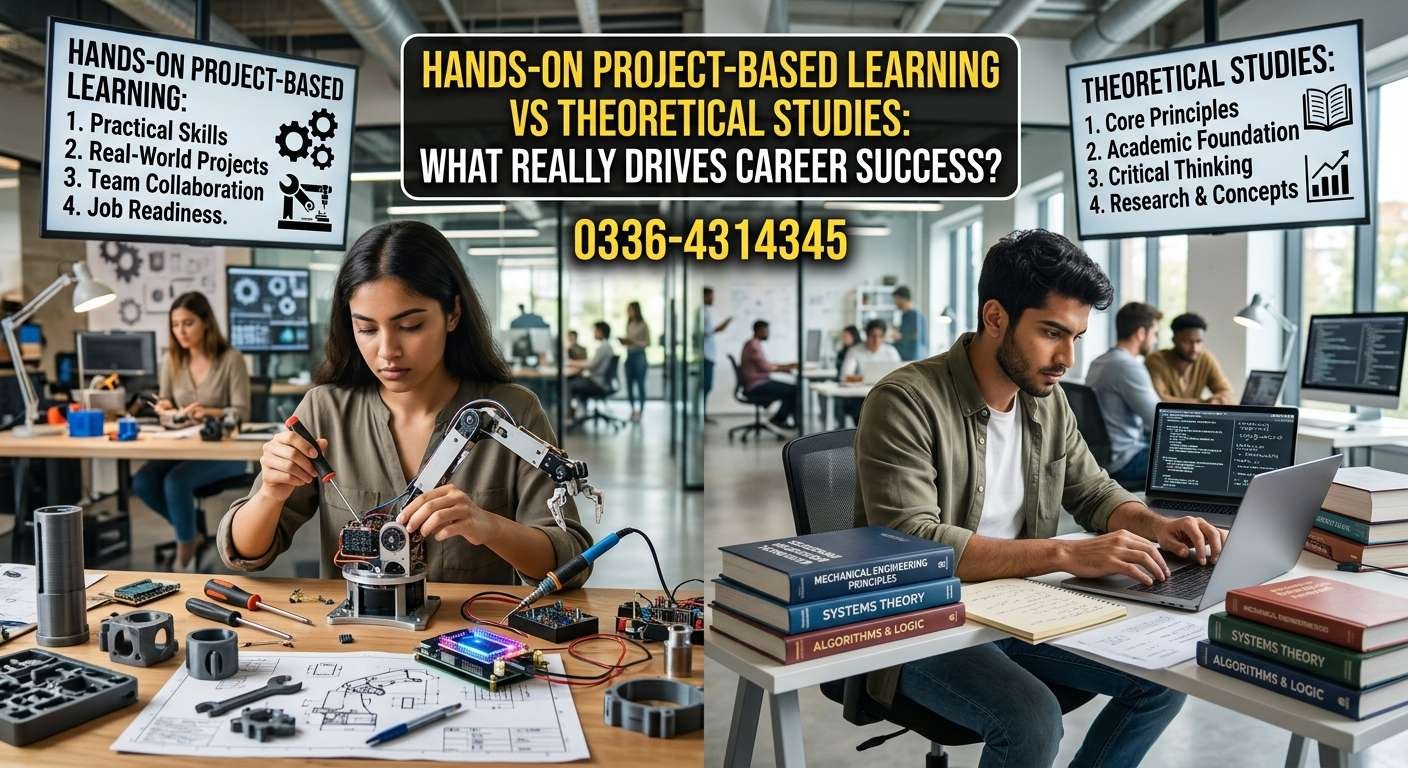
In today’s fast-changing job market, the debate between Hands-On Project-Based Learning and Theoretical Studies is more important than ever. For decades, traditional education systems have relied heavily on textbooks, lectures, and written examinations. While understanding basic concepts remains helpful, theoretical knowledge alone often fails to prepare individuals for actual workplace challenges.
Employers today look for practical expertise. They need professionals who can create functional designs, build scalable applications, optimize search campaigns, and handle dynamic market conditions right from the start. In this article, we examine the main differences between project-based learning and traditional theoretical studies, showing why practical experience provides a clear advantage across modern technical and creative fields.
The Limitations of Purely Theoretical Studies
Theoretical studies focus on foundational principles, background concepts, and abstract rules. Students memorize theories and write papers to demonstrate understanding. While this academic approach offers a basic starting point, it has several clear limitations:
- Lack of Practical Execution: Understanding how a concept works on paper is very different from applying it in a live production environment.
- Slower Adaptation to Industry Changes: Academic curricula often take time to update, falling behind real-world tools, software, and framework updates.
- Lower Knowledge Retention: Passive listening and textbook reading generally lead to lower long-term retention compared to active problem-solving.
- The “Fresh Graduate” Challenge: Many graduates complete theoretical programs with strong degrees but struggle in interviews when asked to present a practical portfolio.
Why Hands-On Project-Based Learning Wins
Project-based learning shifts the focus from passive reading to active creation. By working on realistic assignments, building portfolio projects, and solving live technical challenges, learners connect theoretical concepts with actual practice.
Here is how practical project-based execution improves skill development across key modern industries:
1. Creative Design and Digital Media
Reading about visual balance or color theory cannot replace the experience of creating actual media assets. Developing professional skills in Graphic Designing requires consistent practice with design software, brand assets, and visual layouts. Similarly, understanding user experience requires wireframing and testing through dedicated UI/UX Designing.
When visual artists move into motion graphics, practical editing environments become essential. Creating engaging promotional content through Video Animation requires hands-on keyframing, timeline arrangement, and video rendering rather than simple textbook study.
2. Software Engineering and Quality Assurance
Programming cannot be mastered by reading code examples alone; developers must write, test, debug, and publish functional code. A clear understanding of web structure, database integration, and server configuration comes naturally through practical Web Development. Likewise, creating features for modern mobile devices requires direct application in Mobile App Development.
Quality assurance works alongside development. Writing test scripts, locating bugs, and verifying application stability are best learned by using testing frameworks in Software QA Testing.
3. Digital Marketing and E-Commerce Execution
Modern marketing strategies rely on active performance tracking and platform data. Setting up campaign targets in practice is very different from studying theory, especially when managing visibility using SEO / SMM techniques. Building broader growth strategies requires active practice in Digital Media Marketing.
For online businesses, managing storefronts, product setups, and supplier connections requires hands-on operation. Learning to run a store involves practical exposure through E-Commerce. Specialized store models also benefit from step-by-step guidance, as seen in training for Amazon Dropshipping and operational setups for ebay Dropshipping.
4. Artificial Intelligence and Emerging Technologies
Artificial Intelligence is changing many industries, making practical skills essential for modern professionals. Building and training predictive models requires hands-on work with data pipelines in Machine Learning AI. Digital creators can also streamline content production by using prompt tools in Video Creation with AI.
Starting early helps young learners build creative problem-solving skills. Children can learn digital design fundamentals through Designing with AI For Kids, while early technical thinking develops naturally through structured Coding with AI For Kids.
5. Workplace and Office Administration Skills
Essential business and administrative roles also benefit from practical application. Managing documentation, organizing computer files, and handling workplace routines are most effective when practiced in simulated business settings focused on modern Office Management.
Comparison: Project-Based vs Theoretical Learning
| Feature | Theoretical Studies | Hands-On Project-Based Learning |
| Primary Focus | Concept acquisition & theory | Practical application & project output |
| Learning Method | Passive (lectures, reading) | Active (building, testing, troubleshooting) |
| Output | Written exams and academic papers | Websites, applications, designs, and campaigns |
| Job Readiness | Often requires additional training | Prepares learners for practical tasks |
| Skill Retention | General concept memory | Practical knowledge gained through experience |
Conclusion: Building Career-Ready Skills
While theoretical study offers helpful context, project-based hands-on execution builds practical confidence and verifiable portfolios. Whether you want to write code, design user interfaces, manage marketing campaigns, or run an e-commerce business, real-world application is the key to developing lasting skills.
By focusing on project-based learning and practical execution, you prepare yourself effectively for new career opportunities in today’s digital economy.